Anticipate risk. Take control before an incident occurs.
What is it?
Solución digital integral, basada en modelación matemática, que da visibilidad al riesgo en tus operaciones para así gestionarlo de manera preventiva y personalizada.
Full integration for effective risk management
Integrate your devices to take full advantage of Risk 360 features.
Leverage data from our other products integrated with Risk 360.
Identify the highest-risk workers and the root cause of their risk.
Manage risk events early and effectively.
What is it for?
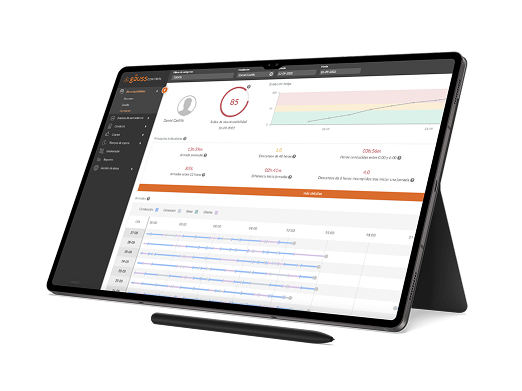
By integrating data from multiple sensors such as DMS, ADAS, and GPS, Risk 360 models risk at the individual driver level to segment workers and identify the source of their risk. This enables early and effective management of different risk events through our advanced management software.
Risk Prediction Models
Gain visibility into risk and predict it with our Biocompatibility Index (IBC), Accumulated Fatigue Level (NFA), and Gauss Risk Index (GRI) models.
Risk Prediction Models
Gain visibility into risk and predict it with our Biocompatibility Index (IBC), Accumulated Fatigue Level (NFA), and Gauss Risk Index (GRI) models.
Visualiza y anticipa el riesgo antes del accidente.
Model and visualize each driver’s risk level based on IBC, NFA, and GRI, identifying at-risk workers before an accident occurs to enable preventive and personalized risk management.
Visualize and anticipate risk before an accident occurs.
Model and visualize each driver’s risk level based on IBC, NFA, and GRI, identifying at-risk workers before an accident occurs to enable preventive and personalized risk management.
Advanced analytics for more precise risk management.
Our advanced mathematical models generate detailed analysis and driver-level insights, providing visibility into data that would otherwise be unavailable and enabling actions to prevent and manage operational risk. In addition, we integrate with multiple telemetry providers, making Risk 360 applicable to any business regardless of the telemetry systems it uses.
Advanced analytics for more precise risk management.
Our advanced mathematical models generate detailed analysis and driver-level insights, providing visibility into data that would otherwise be unavailable and enabling actions to prevent and manage operational risk. In addition, we integrate with multiple telemetry providers, making Risk 360 applicable to any business regardless of the telemetry systems it uses.
Frequently Asked Questions
What does the Gauss Risk device assess?
Cognus assesses the driver’s physical and cognitive condition before the shift begins, evaluating fatigue, reaction time, and concentration in just a few minutes to help ensure a safe start to the shift.
How long does an assessment with Gauss Risk take?
How long does an assessment with Gauss Risk take?
Does Gauss Risk require complex installation or constant maintenance?
Real cases, measurable results
SQM, one of the world's largest non-metallic mining companies and a global leader in lithium production, implemented Gauss Control in its transportation operations in the Atacama Desert. The company sought to improve road safety in a 24/7 operation that transports critical materials across hundreds of kilometers every day.
COPEC, a leading fuel distribution company in Chile, implemented an innovative Fatigue Risk Management System (FRMS) through the Gauss Control platform. The initiative aimed to further strengthen its high safety standards and protect more than 1,200 drivers across the country.
ENAP, Chile's National Petroleum Company, which operates critical fuel transportation services, strengthened its commitment to road safety by adopting a Fatigue Risk Management System (FRMS) based on the Gauss Control platform and Guardian sensors from Seeing Machines.